Since 15 September, INCIPIT has experienced ten crazy, or magical, days. Great news was concentrated in these days, some of which had been in the pipeline for many months. It is worthwhile to highlight each of these occasions.On Friday 22 September, the Ministry of Science announced that Felipe Criado-Boado, member and director of the INCIPIT, had been awarded the National Research Prize. The ministry's press release noted that the "Ramón Menéndez Pidal" Prize in the area of Humanities, "has been awarded to him for his pioneering and innovative contributions to archaeology, which have contributed to our understanding of how human societies have interacted and modified the landscape over the course of history. Also noteworthy are his recent studies examining how the world we build and inhabit changes our minds and the way we process information". The justification for the award ends by adding that "his unique lines of research have led to paradigm shifts in archaeology and the incorporation of new concepts and applications".On Thursday 28th, José Carvajal took up his post as Research Scientist at the CSIC, stationed at the INCIPIT. José is a specialist in ceramic studies (especially petrography), but he has also developed studies of material culture, architecture and landscape. His area of research is Islamic archaeology at a global level, and he is particularly interested in questions related to the processes of Islamisation. He has worked especially in Iberia and Qatar, but has also been involved in other countries: Albania, Greece, Turkey, Palestine, Morocco, Kazakhstan. He is currently vice-president and trustee of the International Association for Arabian Studies, and co-president of the Organising Committee of the Arab Studies Seminar. José Carvajal joins the CSIC coming from a permanent position at the University of Leicester, UK. He has spent his professional career mainly in the UK.On Tuesday 24th, Maria Ximena Senatore brilliantly won, with the highest score, a post as a Research Scientist at the CSIC for the INCIPIT with the profile "Archaeology and Polar Heritage". Ximena is a specialist in historical archaeology. Her research career (in Argentina and Spain) has focused on studies of modernity, capitalism and colonialism in contexts of southern Patagonia and Antarctica. Her recent research includes analyses of contemporary heritage processes, especially in Antarctica, with the aim of generating proposals for sustainable and inclusive policies and practices for their conservation.On the 15th, the State Research Agency's decision on the calls for postdoctoral contracts for the current year was made public. Two INCIPIT postdocs were awarded Ramón y Cajal contracts. Pau Sureda Torres and Carlos Tejerizo. The former will certainly join our institute. Pau Sureda Torres has been a postdoctoral researcher at INCIPIT since June 2017. He currently holds a Juan de la Cierva-Incorporación contract. His research focuses on the Prehistory of the Western Mediterranean, especially on the Chalcolithic and Bronze Age societies. He directs excavation projects at sites in the Balearic Islands, Corsica and Sardinia, studying their human colonisation and adaptations to the island environment. He also carries out studies on ancient metallurgy, focusing on its technology and the importance of these objects for the configuration of exchange networks in the past.In the call for Juan de la Cierva postdoctoral contracts, resolved on the same day, three candidates were selected for the INCIPIT.Alejandra Galmés Alba, whose research focuses on the Balearic Islands where she is developing innovative methodologies to analyse the visual impact of monumental architecture on the landscape. She is currently studying how Talayotic architecture created networks of visibility that generated a connected landscape on the island of Menorca during the first millennium BC. Her research contributes to understanding the role of visibility during coastal navigation in the late Bronze Age. She has collaborated in the candidacy of Talayotic Menorca which has just been selected to enter the UNESCO World Heritage list (a candidacy in which different members of the INCIPIT were involved and which our institute congratulates).Samuel Nión Álvarez researches Iron Age and Roman societies in Atlantic Europe (first millennium BC). His work deals with the study of social processes, power dynamics and cultural transformations, combining the study of materiality through various methodologies (archaeometry, chronostatistics, sociometallurgy and studies of domestic space) with theoretical reflection on the processes of knowledge creation. He stands out in the application of approaches based on anarchist anthropology to rethink the development of power in ancient societies, a line of research explored for some time by the INCIPIT and the USC and which is being reinforced by the most recent bibliography.Maria Silva Gago trained in Human Evolution. Her research focuses on studying the interaction between humans and the material world through visual behaviour when facing different types of archaeological artefacts. She uses eye-tracking technologies to understand how material culture is perceived over time. She has analysed differences in the visual behaviour of early stone tools, and is now focusing on the perception of Palaeolithic parietal art as one of the earliest evidences of symbolic behaviour.Meanwhile, Laura Muñoz-Encinar led, in collaboration with Zahira Aragüete Toribio, a training school on "Unearthing Traces of European Conflicts: Materiality, Memory, &Technology" from 26-28 October. This activity is part of Laura's line of research in Forensic Archaeology focused on the study of 20th and 21st century conflicts. It is part of the Cost Action TRACTS: Traces as Research Agenda for Climate Change, Technology Studies, and Social Justice. It involved 21 young researchers from different parts of the world (Colombia, Croatia, Portugal, Papua New Guinea, Italy, Germany, Spain, Ukraine and Poland). They have explored the material traces of conflicts and their impact on the present through the combined conceptual lens of Archaeology, Forensic Sciences, Social Anthropology and Memory Studies.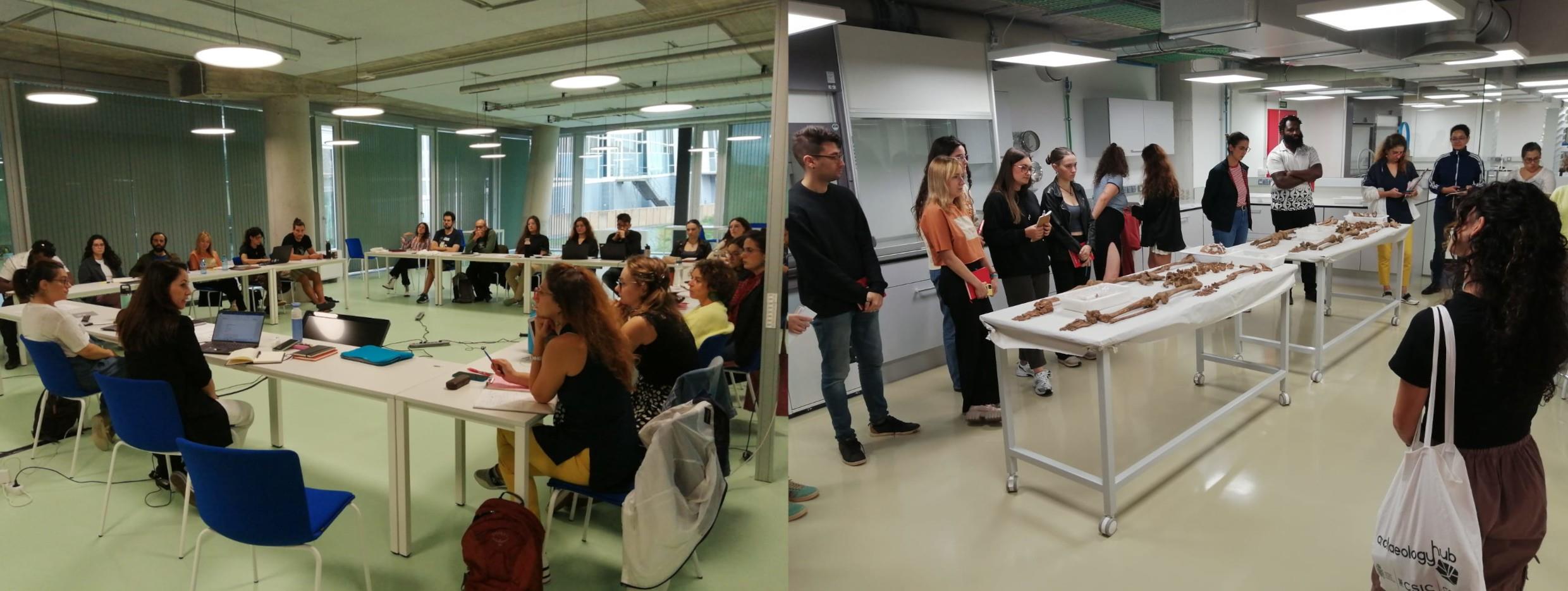 In addition, the INCIPIT management team has recently been reinforced with the incorporation of Javier Castro Rey and Alexandra Alonso. In a team as dynamic as the INCIPIT´s, we cannot forget the importance of having a network to support and take care of administrative procedures. Unfortunately, the necessary maintenance and reinforcement of the administrative and technical teams is often the most difficult part of the scientific work chain to cover. It is therefore good news that our administrative team has been reinforced with these new additions.